Book A Free Consult
Support, Asset Divison & More
Everything You Need To Know
Your Questions Answered





Divorce is the legal word for the termination of a marriage. In Australia, there is no need for there to be “fault” in order for the divorce to be permitted. So even if only one partner wants out of the marriage, the court will grant a divorce order. But there is still a legal process involved that generally takes up to a year to complete.
Issues related to Divorce Process in Australia are covered in Part VI of The Family Law Act, 1975 (link to the law). The law says that a divorce order is based on “the ground that the marriage has broken down irretrievably”.
Before one or both partners may file for divorce in Australia, they must be separated for a period of one year and a day. This is in order to show that the ground for divorce – the breakdown of the marriage – really exists. While no fault must be shown, the law considers divorce a serious matter. By requiring this long period of separation, a couple is required to think very carefully about their decision to terminate their marriage. A court may ask for proof of the separation during the hearing (to be discussed further).
It is important that one partner officially notify the other that he or she wishes to separate. This can be done verbally but a written notification is even better and can be used in court in the event that questions arise about the date of separation or whether it happened at all.
One or both partners must fill out a standard Application for Divorce. This form may be found on the Family Law Courts website. It requires a good deal of information, including personal details about each partner, financial information, questions about a property, and details about your children (if you have any) and custody arrangement if they are under 18 years of age.
While this application can be completed without a lawyer (other than the affidavit in Part G), it’s useful to consult with a lawyer to be sure that you’ve completed the application properly and accurately.
You must file the Application for Divorce in three copies – an original and two copies, along with a copy of your marriage certificate and any other accompanying documents (see below). This packet can be filed at the nearest family law registry or online at www.comcourts.gov.au.
There is a fee for submitting an Application for Divorce. As of January 1, 2013, the fee is $800 but it is also possible to obtain a reduced fee.
Once everything is filed and paid for, you’ll receive a file number and a time and date for your hearing.
If you filed your Application for Divorce together with your spouse, then nobody needs to have the application delivered to them.
If you are submitting the Application for Divorce alone, you need to serve your spouse with a copy of the application, the “Marriage, Families and Separation” brochure and any other documents you filed with the court (except the marriage certificate).
The Divorce Service Kit details how these documents are to be served on the other spouse. Consult with a lawyer before taking any legal action to be sure that you understand all of the implications of your actions and that delivery is done correctly.
You are not always required to attend the hearing.
If there are no children under the age of 18, neither you nor your spouse needs to attend the hearing.
If this is a sole application (not joint with your spouse) AND there is a child under 18, you must attend the hearing.
If this is a joint application, regardless of the age of the children, neither of you needs to attend the hearing.
The hearing allows the judge to ask any questions regarding the Application for Divorce Process in Australia. If the judge decides on more information, he or she may schedule an additional hearing. If the judge is satisfied with the application, a divorce order is granted at the conclusion of the hearing. The order becomes final only one month later.

Your client who is going through a matrimonial/de facto property settlement may say to you that their particular contribution to the accumulation of the asset pool was ‘special’, by which they mean that:
In this article, we review the current law on ‘special contributions’ and how you might respond to your client’s claim.
The second step of the ‘4 Step Process’ for determining how the assets of the marriage ought to be divided between the parties includes consideration of the contributions of the parties.
Contributions may be:
A party may claim that they made a ‘special’ direct financial contribution which warrants them receiving a greater share of the asset pool.
Examples of ‘special contributions’ include contributions made by:
The existence of a ‘Doctrine of Special Contribution’ was recently reviewed, and rejected, in the decision in Kane v Kane by the Full Court of the Family Court [2013].
The parties had been married for 30 years. The issue in dispute was the weight to be given to their respective contributions to their self-managed superannuation fund. The husband sought a greater share of the fund based on his ‘special contributions’, being ‘the application of his acumen to investment decisions which caused the fund to prosper’ (from $540,000 in 2008 to $1,850,000 in 2012). The husband, with the wife’s consent, purchased shares using matrimonial savings. The shares were registered separately in the name of the husband or the wife, with different rates of growth in their respective portfolios. The husband asserted that this separation evidenced the parties’ shared intention to benefit individually and not collectively, from their respective portfolios only. The wife asserted that the husband had merely invested their savings and they should benefit equally in the overall growth. The husband took principal responsibility for the investments and the wife was content with this (not unusual) arrangement although in evidence she conceded that she was unenthusiastic about the husband’s wish to invest in a particular share purchase. The husband asserted that he carefully researched each investment before deciding to purchase and that the success of the investment was due to his judgment and not mere chance or a random lottery win.
The trial judge held that ‘the evidence in the present proceedings permits a rational conclusion that the acquisition of those shares was no fluke. The husband’s diligent research of that corporation and his decision to invest the parties’ funds in it was an inspired investment decision, manifesting considerable expertise. His decision is all the more remarkable given that he knew he was making that investment decision without the support of his wife. I am satisfied that, without the husband’s skill in selecting and pursuing the investment in Company 1 shares, the parties’ superannuation interests within R Investments would currently be worth substantially less. It follows that the husband’s contributions to those superannuation interests were substantially greater than those of the wife. I reject the wife’s submission that her contributions were equal to those of the husband. The real difficulty is evaluating the parties’ contributions in mathematical terms.
The trial judge split the funds’ two-thirds to the husband and one-third to the wife.
On appeal by the wife to the Full Court of the Family Court, it was held that the trial judges’ disproportionate division of the Fund could not be justified.
On the claim of ‘special contribution’ by the husband, His Honor Deputy Chief Justice Faulks stated:
Family lawyers now have the benefit of a very clear message from the Full Court of the Family Court:
The rejection of the existence of a ‘Doctrine of Special Contribution’ will be most keenly felt by parties with a high-value asset pool which they believe is the result of their ‘special contribution’ over and above the other parties’ contributions.
Family law property matters are complex, and can always benefit from expert advice from a specialist solicitor. Get in touch with Mathews Family Law, and speak with a divorce law and property lawyer to assist you with your separation or divorce.
In 2015, Accredited Family Law Specialist Vanessa Mathews was interviewed by the Herald Sun regarding the Ashley Madison data breach and whether the scandal would lead to an increase in divorce and family law matters.
The Ashley Madison incident attracted significant public attention after confidential user information from the relationship website was exposed, raising questions about the potential impact on marriages and families.
Vanessa was asked whether she believed the exposure would result in a “surge” in divorces and provided her perspective as an experienced Melbourne family lawyer on the likely impact on relationships and separation proceedings.
While issues such as infidelity may contribute to the breakdown of a relationship, Australian family law operates on a no-fault divorce basis. This means that the Court does not determine whether one party was responsible for the breakdown of the marriage when deciding whether a divorce should be granted.
However, the discovery of an affair or breach of trust can have a significant emotional impact on families and may influence the way couples approach:
As Principal and Accredited Family Law Specialist at Mathews Family Law & Mediation Specialists, Vanessa Mathews regularly provides commentary on family law issues affecting Australian families.
Her experience includes advising clients on:
Vanessa’s approach is focused on providing practical legal advice while recognising the emotional challenges that often accompany family breakdown.
Click on the link to read the article
http://www.couriermail.com.au/news/ashley-madison-hack-reveals-more-than-213000-melburnians/story-fnu4vh3q-1227492328816
If your relationship has broken down and you need advice about your legal rights and options, Mathews Family Law & Mediation Specialists can help.
Our Accredited Family Law Specialists provide clear, practical advice to help you navigate separation, divorce, parenting arrangements and property settlement.
Contact us today to arrange your complimentary 15-minute telephone consultation.

At Mathews Family Law and Mediation Services, we have wide experience in matters related to divorce property settlement. We take the time out to understand your concerns and offer the best possible solutions based on your individual situation. Our property settlement lawyers have an unrivalled reputation and can help you make an informed decision. We understand that separation is a stressful phase and assure you that we will be there for you when you need us. Reaching a mutually acceptable financial agreement in divorce can be daunting. With our bespoke service, we will approach your case to deliver a favourable financial outcome. We are driven by the zeal to ensure a fair settlement and you can count on us even for the most complex cases.
Divorce Settlement in Australia
At Mathews Family Law and Mediation Services, we have wide experience in matters related to divorce property settlement. We understand that even if your finances are separate, there is the need for a formal financial settlement. Our experienced lawyers possess the expertise and understanding to enable you to handle the financial aspects of divorce as successfully as possible. We will outline ways to reach a fair settlement so that you do not face any legal disagreements in future. Approachable and experienced, our lawyers will help you get the results you want.
Reaching Financial Agreement in Divorce
After you have taken the decision to divorce, sorting out the financial aspects can be a complex task. There is much to consider but with the backing of our expert property settlement lawyers, you can be sure that you will be supported at every step. We take the time out to understand your concerns and offer the best possible solutions based on your individual situation. Our property settlement lawyers have an unrivalled reputation and can help you make an informed decision. We understand that separation is a stressful phase and assure you that we will be there for you when you need us. Reaching a mutually acceptable financial agreement in divorce can be daunting. With our bespoke service and clear legal advice, we will approach your case to deliver a favourable financial outcome. We are driven by the zeal to ensure a fair settlement and you can count on us even for the most complex cases. We will ensure that your interests are protected and the divorce proceedings are as amicable as can be.
If you have any queries about family law property settlement, do not hesitate to book a consultation. We are here to answer any questions that you may have and will be happy to guide you through the process of a divorce property settlement.
If you have any queries about family law property settlement, do not hesitate to book a consultation. We will be happy to assist you.
Divorce – The Basics
Australia does not require a showing of fault in order to be granted a divorce. For instance, you do not have to show adultery, abandonment, abuse, or anything else to be eligible to apply for divorce. You simply must prove that the marriage has broken down irretrievably, by showing that you have lived apart with the intent to sever the relationship for twelve consecutive months.
Once you have satisfied the twelve-month separation requirement, you may file an application for divorce. You may do so individually or jointly, however should you file individually you will need to serve your ex spouse with the appropriate paperwork. After valid service of process there will be a hearing, and the court will either grant or deny your application for divorce. If the order is granted, it will automatically become effective one month after it is issued.
Divorce is fairly straightforward, and simply denotes the end of a marriage. The process is easy to follow, and the necessary forms can be found online or you can have a lawyer apply for a divorce on your behalf at www.divorce-online.com.au.
Should you anticipate that your divorce would involve more complex issues or questions related to property division, custody and maintenance, then contact Mathews Family Law to discuss your situation with a specialist family law attorney today.
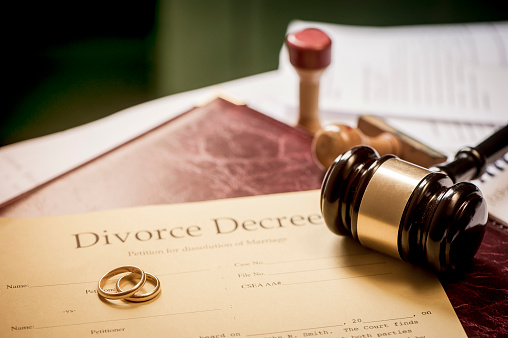
The Australian family law is unique in a way that it does not require the divorce applicants to prove the fault of any partner. This is called a no-fault divorce. All that is required is that the partners have been separated for a period of 12 months and that there are no chances of their getting back together. It is also not necessary for a joint divorce application to be filed. Australian family law allows either partner or both jointly to file an application for divorce.
The court needs to be certain that the marriage has broken down irretrievably and that there is no hope for reconciliation at all. This requirement is particularly acute if the partners have been married for a period under two years. To ensure that the partners are not getting a divorce in haste, the court requires a certificate signed by a counseling agency to be filed with the divorce papers. This certificate attests that the partners have sought counseling as a means to seek reconciliation before applying for a divorce process in Australia. Similarly, if either spouse cannot be traced, the applicant can pursue the divorce application as long as they demonstrate that they have made efforts to locate the untraceable spouse.
Usually, the divorce proceedings do not take much time if there are no minor children involved. However, if the custody of children under 18 is an issue, then the applicants need to demonstrate that they have made adequate arrangements for the care of their children after the divorce. More so, unless a joint application is made by both partners, the applicant needs to be present at the hearing if there are children under 18 involved.
If either partner wishes to oppose an application of divorce filed by the spouse, he or she may file a response to the divorce application or a response to the jurisdiction if they feel that the divorce has not been filed in the right jurisdiction.
Many people find it more convenient to fill out electronic forms compared to a hard copy. The Australian family law accepts divorce applications that are submitted electronically. Applicants can fill out a form for filing for divorce online and submit it through the electronic portal along with the fee and the necessary accompanying documents.
The online submission process has been made easier to facilitate the applicants. For the most part, the online form has exactly the same questions as the hard copy. However, it is more convenient to fill out due to some special features. One such feature is the validation feature. This feature notifies the applicant if he or she has skipped any question before moving on to the next page. This minimise s the risks of filing an incomplete form.
Secondly, the online form only presents questions that are relevant to the applicant. This saves a lot of time that would otherwise have been spent in going over every question on the form. The online form also provides pointers i.e. information to help the applicant provide complete and accurate responses.
The applicant can easily save the completed divorce application in the form of a PDF file on computer. The applicant can then submit the form electronically through the web portal of the Commonwealth Courts. Some of the necessary document can also be filed electronically. At the same time, the form is also saved automatically on a separate database from where it is automatically deleted after two months.
No separate charges are applied on filing the divorce application electronically. Only the standard prescribed fee for filing an application for divorce needs to be paid by the applicant. All efforts have been taken to make the process of filling out and submitting the online application smooth and hassle-free. However, the family law registry is open to provide a complete divorce kit that answers any particular queries and problems experienced by the applicants.
The divorce kit provides all the information that an applicant needs to file for divorce in Australia. The divorce kit outlines the steps one needs to take to apply for a divorce. It also provides the application form to be filled in by the applicant. There is no standard format of the divorce kit as it is provided in a number of different formats. The applicant can choose the one that best suits their needs after consultation with a divorce lawyer.
The divorce kit also provides an online version of the application form that needs to be printed out after it has been filled in by the applicant and then submitted to the Federal Magistrates Court. The Federal Magistrates Court Rules provide that the application form be printed on one side of the sheet only. The kit also specifies the fees that the applicant needs to pay at the time they submit the application form with the Federal Magistrates Court. The kit also specifies the instances where the applicant may be entitled to a reduction in the divorce fee. The law allows for the payment to be made in cash as well as via cheques, money orders and credit card.
In addition to the above, the divorce kit also contains information about the process to be followed during court hearings and how the outcome of the application is being determined. Applicants can use the application form to fill in details of up to four children. Applicants who have more than four children can use the special attachment form that comes with the divorce kit. Finally, the online application form can also be submitted electronically through the portal of the Commonwealth Courts. The divorce kit is an indispensable tool for divorce applicants and may be the best source of information on how to get a divorce in Australia.
Hi, I’m Vanessa Mathews from Mathews Family Law & Mediation Specialists. Today I want to discuss a number of issues related to divorce.
I want to stress that these issues are best handled by a lawyer. I would encourage you to talk with a lawyer and to read more about these issues on our website before you take any steps on your own.
Divorce, according to Australian law, is the end of a legal marriage. That is, it’s a change in status for those in the couple. From a legal angle, it only involves those two people, not their children, not their property or the financial obligations they might have.
While all of those factors are affected by divorce, divorce itself is a fairly straightforward matter in Australia. Also, at least for now in Australia, legal divorce can only happen between a man and a woman. That’s because marriage in Australia is only legally recognised between a man and a woman.
Other couples, like same sex couples or couples who had been living together for a long time but chose not to get married, may be recognised as what’s called de facto couples. They may have many of the same rights as a married couple. But, if they choose to end their relationship they do not have to go through the process of divorce.
Divorce in Australia is no fault. This means that there doesn’t have to be a reason given for the divorce. If even one person wants to end the marriage, to get a divorce they have the legal right to end it.
There are, however, a number of conditions that need to be met before a couple can get divorced. You must be separated from each other for at least 12 months and 1 day. The court may even ask for proof that you were separated for this period of time before granting the divorce.
While generally separation means living apart from one another there are cases where a couple is considered separated even though they live in the same home. But, in this case the burden of proof is even greater, and there are a number of conditions that must be met.
So, if you are separated but living together in the same house, make sure you meet those other requirements. They include not having sexual relations, living in separate rooms, not attending social functions together, and not providing household services to each other like cooking and laundry. This shows the court that you really have ended your relationship. You can read more about this on our website.
Once you’re separated for a year and one day you can fill out an application for divorce. The application mostly asks about personal details like name, addresses, details about children, and the marriage and separation date. But, it also asks if there are other outstanding family issues in the court like property division, and this information needs to be listed.
The application must be signed in front of a lawyer, or justice of the peace, or someone else who can witness a document. Then, it’s filed with the court along with two copies and a copy of your marriage certificate. There is also a fee that you’ll need to pay when you file the application.
If you both wanted the divorce and both filled out the application then you’ll each get a copy from the court and wait for a hearing date. If only you filed the application then you have to serve the application on your spouse which means that your spouse has to get a copy of the application. Generally, a spouse is served by sending by registered mail. Your spouse can receive the application personally by hand, but you may not bring it to him or her. Someone else over the age of 18 has to serve him or her by hand.
Now, again, Australia has no fault divorce, so if one person wants the divorce there isn’t much the other spouse can do to prevent it. But, once the other spouse has the application he or she can fight the divorce by filing what’s called a response to divorce and claiming there wasn’t a separation of 12 months and 1 day or by arguing that the particular court doesn’t have the right to hear this case. Then, the case will have to be heard by the court.
But, assuming the other partner doesn’t fight the application, you will have a hearing at the court to just verify the facts of the case. The law doesn’t require everyone to attend the hearing, but you do have to go to court if you have children under 18 and only one of you apply for the divorce. If you filed a response to divorce you should probably go to the court since the judge will want to hear from you.
Now, I want to talk a bit about what happens in court. This is often scary for people, partly because just the idea of being in court is frightening and also because of the emotional side of divorce. But, it’s just a formal procedure where the judge or the registrar reviews the application. He checks that everything written is correct. The judge might ask you or your spouse some questions, too. If you have children, the judge will also want to know that everything is arranged for them, things like where they’ll live and how they’ll be supported.
Once everything is clear to the court they’ll announce that the divorce is complete and the marriage has ended. You’ll get a divorce order from the court through the mail, and this is proof of the divorce. The divorce is actually final only one month and one day from the date of the hearing. Only at that point, one month and one day, can you remarry.
You can find the application for divorce on the Internet, but we recommend you speak to a lawyer to be sure you haven’t missed out anything and to make sure you know all of your rights. You may also like to visit our online divorce service, onlinedivorce.com.au.
Thank you for watching this video. I’m Vanessa Mathews from Mathews Family Law & Mediation Specialists.
Hi, I’m Vanessa Mathews for Mathews Family Law & Mediation Specialists, and I’m going to be talking about property distribution today. Property distribution is about how the assets and liabilities of the marriage or de facto relationship are divided.

Assets are the things of value that you own, like, a home, a car, a bank account, investments, savings, superannuation, and furniture. Liabilities are the things you owe to others, like, a mortgage or a loan or even credit card debt.
For the most part, when it comes to questions of property and property division, de facto couples have the same rights and obligations as married couples. But some of the laws are different for de facto couples, depending on the state or territory they’re living. So you should always get professional legal advice to be sure how the law applies to your particular situation.
When a couple splits up, if they are married or if they’re in a de facto relationship, all of their property, both the assets and the liabilities, have to be divided between them. That is, they have to decide who owns what and who owes what.
When people come to me for help, I often hear things, like, ‘I don’t have to give him anything. I earn all the money, so it’s all mine.’ Or ‘She spent so much of our money over the years, she doesn’t deserve anything.’ Well, the law doesn’t work on emotions, but instead on the assumption that both people contributed to the marriage, perhaps in different ways, but both worked for the benefit of the shared union.
Now, some couples divide their property by themselves or with help from friends or professionals. If you choose to work it out just between the two of you, you can decide to split your property however you like. Generally, if you work with lawyers or through mediation, you have to follow the same four-step process the court uses, which I’ll discuss later on.
You can also do this property division at any time before you’re married and this is called a prenuptial agreement or even after you are married or when you’re in the process of divorcing.
Once you come to an agreement and sign this document, you can submit it to the court by applying for a Consent Order, if you want to, but you don’t have to. The court will allow you to make your own decisions but will want to know that each of you had professional advice when you made the agreement so that one side is not being duped or misunderstood something.
A Consent Order means your agreement has the strength of a court decision. So if one side breaches or goes against the agreement, you can take action against them immediately, without having to first sue, and get a court verdict.
If you can’t work out the property issues on your own, you can go to the court and let a judge decide for you. The law has a very logical approach to dividing up the property, which is the four-step process I mentioned earlier. The first step is to figure out what actually are the marital assets and debts. You can start out by putting everything together, the house, cars, mortgage, loan, furniture, and calling that your property. If the couple has been together for only a short time, the court might remove certain things from the pile of matrimonial property. These are things that belonged to each individual before they married or started their de facto relationship.
So if you brought a car or a house to the marriage, and then you got divorced, the car would be yours. In the same way, if you came with a mortgage to the marriage, that debt is still yours if you get divorced.
But if you’re married for say, 10 or 15 or 20 years, a court, if it goes to court, will probably consider most of your joint marital property. And despite the rules in other countries, even property one partner may have inherited during the marriage or de facto relationship, is still considered joint marital property.
The second step of this four-step process is to consider the contributions each side made to the marriage. There are two types of contributions partners can make. One is clear financial contributions, like, salaries, other types of income, inheritance, actual money or some type of physical property. But there are also non-financial contributions. For example, if one parent stayed home to take care of the children, they’ve contributed by saving money on daycare and enabling the other spouse to develop professionally and earn more. And by simply helping the family unit develop.
The next step is to consider the future needs of each partner. If the couple is older, and one partner never worked outside the home, the court will take into consideration that he or she may need more of the joint property, since they are less able to now go out and find a job. On the other hand, the court will also note that there are no small children, the mortgage is paid off, and there are no large expenses to be paid. So the financial needs are smaller than they once were.
If both people are young professionals with a good future outlook, the court will take that into consideration too. Also, does one partner still have to stay home to care for the children for an extended period of time, leaving them with less income? The court will also look at the health of each person. The one thing the court does not consider is whose fault is it, that the marriage or de facto relationship ended.
Australia has no-fault divorce, meaning there does not have to be a reason or cause for the divorce, other than one side asking for it. So blame has no impact on the property.
The fourth and final step is for the court to take all of this into consideration and make a just and equitable division of the property. That is, the court will split up the assets and the liabilities in a way that gives each partner what he or she needs and deserves. Just and equitable doesn’t mean everything will be split evenly and each person gets 50 percent. When the court decides who gets what and who pays what, the court will explain how this process will work.
So if the superannuation needs to be split, but the side can only get money in ten years, the judge will need to decide what happens in ten years or if there is a house and its value needs to be split between the two sides, the judge will decide if it should be sold, and the money from the sale divided or if one person will pay the other person his or her share, or if one person keeps the house and the other gets some other property of equal value.
A few suggestions I would make when you begin thinking about dividing your property, make sure that as you create a list of your assets and liabilities, you don’t overlook anything significant. For example, people often forget superannuation or other retirement plans.
If you’re thinking about separating or if you’re in the process, and the need to be plain about how you’re going to deal with your property, start gathering documents, like, financial statements, tax returns, mutual fund statements, bank statements, check account statements. Make copies if you can, and keep them in a safe place.
If you have questions about property distribution or any of the issues related to divorce and separation, please visit our website, and feel free to call me to set up an appointment. I’m Vanessa Mathews from Mathews Family Law & Mediation Specialists.

Choosing a divorce lawyer in Australia should be like making any other big Should be divorce process like when you buy a house or choose a school for your children. Educate yourself, ask around, ask questions, and research on the internet.
Learn about the divorce laws first. This is important for two reasons. One, it will give you an idea of what’s involved, which in turn gives you a better sense of control. The second reason is that it means you’re better informed, so when you start looking for a lawyer, you’ll better understand what he or she is talking about.
Ask friends and family, call your local law society, ask others who have been through a divorce, and search the internet. Build up a list of names, including lawyers people recommended not to use.
Ask yourself what kind of person you want to work with. Are you looking for an aggressive fighter who will get you everything you want and win the battle or do you want someone who can get results with a more gentle approach? Do you need someone who will explain everything to you each step of the way or do you prefer to let go and leave the whole burden to the lawyer?
Do some background checking on the names you received. Look them up on the internet. If he or she wrote any articles or papers, read them. This will give you a sense of who this person is and their knowledge of the field. Ask other people who used the lawyer. A few bad recommendations should tell you not to hire this person.
Family law is a very specialized area. Your brother’s best friend might be an amazing criminal lawyer, but that’s not too helpful when you have a parenting dispute with your former spouse.
You can learn a lot just from that first call. How long does it take for the lawyer to call you back? How does the lawyer treat you on the phone? Use this opportunity to ask about fees. You might discover immediately that their price is too high for you. If you decide you do want to meet them, find out if they charge for an initial meeting. Most lawyers do charge for a first consultation.
Set up appointments with the lawyers who sound right. Look at this as a job interview – where you are the employer. How are you treated during the interview? Is the lawyer answering calls or checking emails? Is he slandering other lawyers, or worse, other clients? Do you feel you can confide in this person? Sometimes a first read is not correct, but sometimes it’s good to go with your gut feeling. You know what works for you.
Family law requires knowledge in other fields, such as business, wills, estates, etc. Does the lawyer have other professionals to consult with? You want your lawyer to give you a full picture of the situation and the possible outcomes. Broader knowledge may be required.
An agreement should include what the lawyer’s work will include and his or her fees. Does he work hourly or by the case? What about additional fees or changes in circumstances? Emergencies?


Call Us
1300 635 529
Suite 10, 1 Grattan Street Prahran VIC 3181