Book A Free Consult
Support, Asset Divison & More
Everything You Need To Know
Your Questions Answered







Resource Hub – Articles/Blog
Peter and Claudia were a fantastic father and daughter team, they spent many hours discussing their favorite sports. Peter was deeply involved with Claudia’s home schooling. He lived with Claudia and her mother. One night, though, Peter returned home from shopping to discover both Claudia and her mother were gone. An urgent application was made to the Family Court of Australia and the Australian Federal Police found Claudia safe in West Australia and a few days later she was home safe and sound with her dad. Peter and Claudia continue to spend many happy hours together today.
At Mathews Family Law & Mediation Specialists, we understand that parenting disputes are often the most emotionally challenging aspect of separation and divorce.
For many parents, decisions about where children live, how much time they spend with each parent and how important decisions are made can feel overwhelming.
Our Accredited Family Law Specialists provide compassionate, practical and strategic advice to help parents resolve parenting matters while keeping the best interests of children at the centre of every decision.
Although many people refer to these issues as “child custody” matters, Australian family law now uses terms such as:
Our experienced parenting lawyers assist clients throughout Melbourne, Victoria, Australia and overseas with complex and sensitive parenting disputes.
Australian family law recognises that children benefit from arrangements that support their safety, wellbeing and ongoing relationships with important people in their lives, where appropriate.
When parents separate, they may need to reach agreement about matters including:
Every family is different. There is no automatic preference for mothers or fathers. The focus is always on what arrangements best support the individual child or children involved.
Many parenting disputes can be resolved without going to Court.
At Mathews Family Law & Mediation Specialists, we encourage practical and child-focused solutions wherever possible through:
Our family law mediators and Family Dispute Resolution Practitioners help parents communicate effectively, understand their options and work towards workable parenting arrangements.
If parents cannot reach agreement, an application may be made to the Federal Circuit and Family Court of Australia for parenting orders.
Parenting orders can address issues including:
Court proceedings can be complex and emotionally demanding. Our experienced parenting lawyers provide strategic advice and representation to protect your interests while maintaining a focus on your children’s needs.
At Mathews Family Law & Mediation Specialists, we understand that parenting disputes require more than legal knowledge.
They require:
✔ Understanding of family dynamics
✔ Strong negotiation skills
✔ Practical problem-solving
✔ Sensitivity to the emotional impact of separation
✔ A focus on achieving sustainable outcomes
Our Accredited Family Law Specialists assist parents with:
Clients choose MFL because we provide:
✔ Accredited Family Law Specialist expertise
✔ Experienced family law mediators
✔ Resolution-focused strategies
✔ Personalised advice tailored to your circumstances
✔ Flexible service options including unbundled legal services
✔ Support throughout Australia and overseas
Our aim is to help families resolve parenting issues in a way that minimises conflict and supports children through the transition.
If you need advice about child custody, parenting arrangements, parental responsibility or parenting disputes, our experienced team can help.
Contact Mathews Family Law & Mediation Specialists today to arrange your complimentary initial telephone consultation with an Accredited Family Law Specialist.
We will listen to your circumstances, explain your options and help you take the next step with confidence.
Vanessa Mathews
Principal | Accredited Family Law Specialist | Accredited Family Dispute Resolution Practitioner | Mediator
This page was prepared and reviewed by Vanessa Mathews, Principal of Mathews Family Law & Mediation Specialists. Vanessa practises exclusively in family law and assists clients throughout Australia with separation, divorce, parenting disputes, property settlements, financial agreements and other complex family law matters.
Helping families resolve conflict through specialist legal expertise and constructive dispute resolution.
Last reviewed: 24 July 2026
Disclaimer: This page provides general information only and does not constitute legal advice. Every family law matter is different and you should obtain advice tailored to your circumstances.
Many people searching for advice about “child custody” are really seeking information about parenting arrangements after separation or divorce.
Under Australian family law, the legal terms are parenting arrangements, parenting orders and parental responsibility. The focus is not on one parent having “custody” of a child, but on creating arrangements that promote the child’s safety, wellbeing and best interests.
At Mathews Family Law & Mediation Specialists, we understand that disputes about children are often the most emotionally difficult part of separation. Our Accredited Family Law Specialists provide practical advice to help parents resolve parenting matters in a way that prioritises their children’s needs.
No.
Australian family law encourages parents to resolve parenting issues without Court proceedings wherever possible.
Many parents are able to reach agreement through:
Resolving matters outside Court can often reduce conflict, cost and stress for both parents and children.
Before applying to the Federal Circuit and Family Court of Australia for parenting orders, parents are generally required to make a genuine attempt to resolve their dispute through Family Dispute Resolution (FDR).
If an agreement cannot be reached, the FDR practitioner will usually issue a Section 60I Certificate, which is required when commencing parenting proceedings.
There are exceptions where a certificate may not be required, including circumstances involving:
If parents cannot reach agreement, either parent may apply to the Court for parenting orders.
A parenting order can deal with issues including:
Parenting orders are legally enforceable. Failing to comply with a parenting order without a reasonable excuse may have serious consequences.
Parents who reach an agreement can also record their arrangements in a parenting plan.
A parenting plan is a written agreement between parents that may cover similar issues to a parenting order, including:
However, unlike parenting orders, a parenting plan is not legally enforceable.
For parents seeking certainty and enforceability, formalising arrangements through Consent Orders may be more appropriate.
If a parenting dispute proceeds to Court, the Court’s primary consideration is always:
The Court considers factors including:
Every family is different. There is no automatic preference for mothers or fathers, and there is no “one size fits all” parenting arrangement.
Parenting disputes require careful legal advice and a child-focused approach.
At Mathews Family Law & Mediation Specialists, our Accredited Family Law Specialists assist parents with:
We understand that decisions about children are deeply personal. Our role is to provide clear advice, protect your interests and help you work towards arrangements that support your child’s best interests.
If you are experiencing a parenting dispute or need advice about child custody, parenting arrangements or parental responsibility, our experienced family lawyers can help.
Contact Mathews Family Law & Mediation Specialists today to arrange your complimentary telephone consultation.
Call 1300 635 529 or contact us online to speak with an Accredited Family Law Specialist about your parenting matter.
Vanessa Mathews
Principal | Accredited Family Law Specialist | Accredited Family Dispute Resolution Practitioner | Mediator
This page was prepared and reviewed by Vanessa Mathews, Principal of Mathews Family Law & Mediation Specialists. Vanessa practises exclusively in family law and assists clients throughout Australia with separation, divorce, parenting disputes, property settlements, financial agreements and other complex family law matters.
Helping families resolve conflict through specialist legal expertise and constructive dispute resolution.
Last reviewed: 24 July 2026
Disclaimer: This page provides general information only and does not constitute legal advice. Every family law matter is different and you should obtain advice tailored to your circumstances.
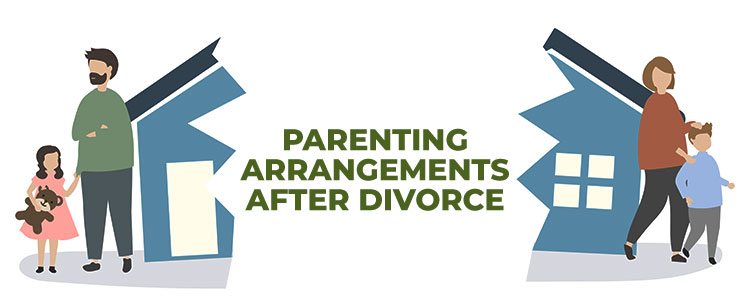
Divorce is painful for everyone concerned, especially children. During this challenging period, children need love, support and contact with both parents.
Creating certainty about the future is crucial for children when their parents separate. Parents coming to a mutual agreement about parenting arrangements can help to provide clarity and certainty.
Following separation, parents may agree on a parenting arrangement that works for them and the children. The agreement should focus on providing for the needs of the children and may include financial arrangements.
A parenting arrangement can be agreed orally, in writing or put into a formal court order known as ‘consent orders’ (which requires an application to the court but does not require a court appearance).
If parents can’t agree on parenting arrangements, they can apply to the court for a parenting order. Usually (except in the case of family violence and other specific circumstances), parents are not permitted to apply for a parenting court order until they have first attempted family dispute resolution (mediation).
The court’s primary concern will be to protect the children from psychological or physical harm. The court will address this before deciding about parenting arrangements.
The Australian Government has published a book to help develop parenting plans. This resource can help prepare clear, practical parenting arrangements that are focused on what’s best for the children.
When making parenting arrangements, parents may consider a range of issues including:
While a routine may be best for your children overall, flexibility is likely to be an essential ingredient of a parenting agreement.
If you are thinking of relocating with your children at a distance that would dramatically affect the time they spend with the other parent, you will need to come to an agreement with the other parent. If agreement is not reached, an application to the family law courts seeking permission to relocate the children will be required.
The proposed relocation destination may involve moving intrastate, interstate or overseas. Consider how the relocation will affect the children’s relationship with the other parent and ask yourself the question ‘Would the move be in the children’s best interests?’ – the court will ask the same question.
Consider what is best for your children’s short-term and long-term wellbeing.
Work out what concerns need to be addressed in your parenting arrangement.
Decide whether you want the parenting agreement to be an informal oral or written agreement, a parenting plan signed and dated by both parents or a court order obtained by consent or by order of the court (judge made order).
Contact an accredited family law specialist or family dispute resolution practitioner to obtain the advice that you need to resolve your post-separation parenting issues. Our specialist solicitors and family dispute attorneys are able to help you with your parental rights.
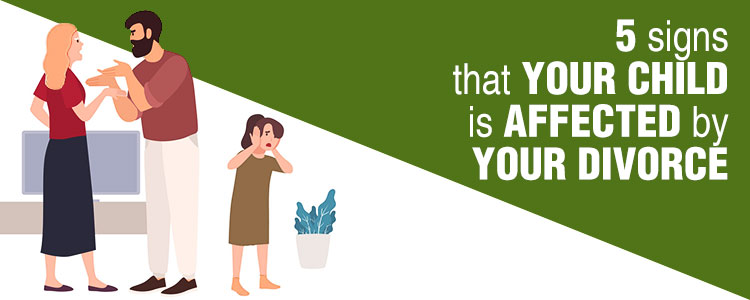
Without special care and attention, children can be the unintended victims of separation and divorce. For them, their parent’s separation can open a floodgate of emotions, which, for children of any age can be difficult to process and express.
Many of the parents we speak with of course to want to minimise the impact of their divorce on their children, but do not always know what signs to look for. So how can you identify the signs that your child may be being adversely affected by your separation and divorce?
Although every child is unique, there are some clear signs to look out for:
Your child could be sad and cry a lot. It might be more difficult than usual to comfort them. They might cry for no reason or react disproportionately to that which to you seem to be minor issues.
The things they cry over may have nothing to do with the separation and divorce however due to difficulty in understanding and accepting the changes to their family, their ability to deal with other issues may be diminished and they can become easily upset.
You or your former partner might find that your children don’t want to leave your side, or that they want to stay with the other parent and resist going with the other parent.
Separation anxiety for children is common when parents separate. Their anxiety is a result of the significant changes they are experiencing and staying close to one or both parents are their way of managing it.
When parents separate, it may cause the children to feel uncertain, insecure, worried or anxious. The complex emotions they feel and their inability to express their feelings may be ‘acted out’, such as angry verbal or physical outbursts or uncooperative behavior. Helping your children to express those complex emotions can help to release the anger and improve their well-being and anxiety.
The stress of parents separating can result in children withdrawing into themselves and refusing to engage in activities they have enjoyed in the past. Some children stop hanging out with their friends, preferring to spend all their time in their room, keeping a distance from their family and doing things by themselves.
When children are tackling a stressful situation at home, it can directly impact on their performance at school. The stress at home takes so much of their attention and energy and they may have difficulty focusing in class.
At home, they may be anxious and distracted, unable to focus on homework, negatively affecting their academic performance.
The dip in academic performance can result in further anxiety for the child; they feel terrible about falling behind, compounding the situation with another stressful situation. If your child is struggling at school after separation, it is a good idea to inform the school about the situation at home.
Separated parents feel responsible for their child’s suffering. Parents must remain united in their commitment to ensuring that any adverse impact on their children is kept to a minimum, and, if any are identified they are immediately met with an appropriate united response. The conflict between parents will certainly exacerbate the impact on the children, potentially dramatically.
If you detect a dramatic change in your children’s behavior and emotions, and your efforts to support them aren’t helping, please seek urgent help. Early intervention can help both you and your children to get the support required to see you through this difficult time.
Recommended Post: Family Violence and Children at Risk
The role of the Single Expert Witness / Family Report Writer was considered in a recent child custody decision by the Family Court of Western Australia (Worrall and Bartley [2018] FCWA 132).

In accordance with an earlier order that the interim parenting arrangements (child custody) for the nine-year-old child (who had been the subject of litigation for eight years) be reviewed after 12 months, the Single Expert Witness / Family Report Writer conducted his review and published a report.
The father sought that final parenting orders (child custody orders) be made in terms of the existing interim parenting orders or otherwise in accordance with the recommendations of the Single Expert Witness / Family Report Writer ‘on the papers’, that is without cross-examination of the parties and/or witnesses.
The mother objected on the grounds that:
His Honor held that:
For these reasons, His Honour declined to determine the matter ‘on the papers’ and the matter was listed for final hearing in the Family Court with cross-examination of the experts.
The Family Court child custody case upholds the principle of ‘procedural fairness and the importance of parties having the right to put all witnesses, including expert witnesses, ‘to the test’.
Mathews Family Law & Mediation Specialists is an award-winning best family law firm in Melbourne’s eastern suburbs recognised for its expertise in complex Family Court child custody matters, with child support lawyers ready to discuss your parental rights and family law property matters.
Please contact Vanessa Mathews on [email protected] or 1300 635 529 to arrange a free telephone consultation to discuss your child custody matter with one of the best family lawyers in Melbourne, accredited family law specialist, Vanessa Mathews.
1. Have a very specific plan for the holidays so there is no opportunity for confusion or conflict. Parents may alternate or split holidays, but when there is disagreement about this plan, consider the longer view of alternating holidays by even and odd years. Holidays are often a time of heightened emotions, and the reality of the loss associated with separation or divorce is no more apparent than when parents must spend a holiday without their children or without old traditions.
2. Try to continue traditions of the past for the children. If they are accustomed to spending Christmas Eve with one extended family, try to continue that tradition, if not every year then in alternate years. Parents should consider maintaining some of the family traditions the first year after the separation, and alternating beginning the following year.
3. If you can continue some traditions together, make them clear, attending to details of who, what, where, when, and how. Some families are able to be together without conflict arising, but parents often have different expectations about the experience itself, as well as the amount of time they will be together. The most important thing for the children is that they do not experience conflict between their parents.
4. Create new traditions that feel special to the children and family. This is an opportunity for the new family configuration to establish new traditions for the holidays including creation of a special holiday celebration or experience on a day other than the actual holiday. It is also an opportunity for the adult who does not have the children, to establish new practices such as time with friends, volunteering, movie days, and travel.
5. Think long-term-what do you want your children to remember about holidays when they have their own children? For children, holidays are magical. It is often the little rituals and practices that are most memorable, such as baking a pie, playing a game or lighting the fire.
6. Remember, children’s memories include all senses what they saw, heard, smelled, tasted and touched. To the extent possible, create a memory that involves each of these senses and describe it, e.g. we always listen to this music, eat cranberry sauce, watch this movie, read this book, take this walk, and cut these branches. Do not allow conflict to enter into these memories.
7. Self-care is very important. Life for the adults has significantly changed. Find new ways to care for yourself, e.g. exercise, friends, books, movies, clubs, martial arts, dance, classes, activities that bring new energy and attention. You want to rejuvenate yourself and refocus on something to help you reconstitute yourself in your new life.
8. Keep your expectations small and be flexible. Focus on one thing that matters most to you during the holidays, e.g. some sense of connection to your family, having sometime with extended family or close friends, creating a new tradition, continuing a tradition. Your holiday time will not be the same, but you can decide that you will have one small goal that you will work toward creating or preserving. Holidays may be accompanied by unmet needs and dashed hopes. By thinking small you can manage disappointment and decrease stress.
9. Though you, the parent, may feel disoriented and lost in the changed family, keep your focus on the children and the new family constellations. Make the holidays about your children, which means helping them to feel good about spending holiday time with the other parent.
10. In ten years or twenty years, what do you want to see when you look back on these years of change? From that long view you can highlight the tone and experience of these transformed holidays. Remember, children who find holidays stressful because of the conflict between their parents, have terrible memories as adults of holidays and of special family moments. It is in your hands to create fond, pleasant memories for your children. They can be traditional or not, but the message is that you and our family are important and we find ways to celebrate and enjoy holidays.
Full attribution to Dr. Robin Deutsch provides consultation, mediation, parenting coordination and expert witness services in Wellesley, MA. She developed and was the director of the Center of Excellence for Children, Families and the Law at the William James College. Previously she was an Associate Clinical Professor of Psychology at Harvard Medical School. Dr. Deutsch was the co-chair of the AFCC Child Consultant Task Force. She served on both the AFCC and APA task forces that developed Guidelines for Parenting Coordination, the AFCC task force for Guidelines for Examining Intimate Partner Violence and the AFCC task force for Court-Involved Therapists. She is the past president of the Massachusetts chapter of AFCC, past president of the AFCC, and former Chair of the APA Ethics Committee.
In June 2018 the Australian Institute of Family Studies (AIFS) released a study ‘Children and Young People in Separated Families: Family Law System Experiences and Needs’ https://aifs.gov.au/publications/children-and-young-people-separated-families-family-law-system-experiences
The study included interviews with children and young people (10 – 17 years of age) who, as a result of family separation, had experienced the family law system.
Of particular importance to those who were interviewed was:
• For their parents to listen to them and take their views into consideration
• For the family law system to listen to them, particularly about safety concerns
• For the family law system to take them seriously
• To be better informed about the family law system
• Speaking to psychologists and counsellors during the family separation process was helpful.
The information provided contributed to the following recommendations:
• Give children and young people the choice to be involved in decision making
• Keep children and young people informed about the decision making process for example important decisions and dates
• Provide children and young children with a clear explanation of the new parenting arrangements
• Ensure children and young people have access to psychologists and counsellors during the decision making process
• Make sure that children and young children are safe and that there is scope to change the parenting arrangements.
The following video provides direct access to the voices of the children and young people: Quotes from the ‘Children and Young People in Separated Families Study’ – https://www.youtube.com/watch?v=9Vaw_hVOoO8&feature=youtu.be
The process of family separation and rebuilding is undoubtedly difficult. The work of organizations like AIFS provide the ‘science’ that is needed to support developments in the complex space that we work within. Our hats go off to AIFS for their hard work, and to the children and young people who allowed us into their world.
For the best advice about your family law parenting matter or family dispute resolution and mediation, contact Vanessa Mathews on 1300 635 529or [email protected]

Dear Friends
Last weekend I attended the AFCC Australian Chapter conference in Adelaide.
The conference topic was ‘Alienation? Myths, complexities and possibilities …’.
The caliber of the papers was excellent.
I was particularly interested in the workshop offered by Dr. Philip Stahl, Psychologist, on domestic violence differentiation, personality disorders and unconscious bias.
Also of great interest was the current research on high conflict separations, alienation and children resisting contact with parents.
Early identification and intervention are the keys to avoiding the escalation of ‘mere conflict’ into alienation and the devastating impact on children (regardless of age).
We heard from our local well-known Psychologists Dr. Jenni Neoh and Ms. Lisa Bottomley in particular about their respective intervention programs for complex family matters.
We often work with families facing experiencing particular difficulty with their post-separation parenting – with young and old children. We will be recommending Jenni and Lisa’s very special approaches to these clients in the hope of achieving an early and effective resolution.
The AFCC website provides a wealth of excellent resources, including conference papers http://afccnet.org.au/ . You may like to consider becoming a member.
We continue to offer a free initial telephone consultation to your clients in need of family law advice – they simply need to call us on 1300 635 529 or email [email protected] to book a time for one of our family law specialists to speak with them.
And remember, we’re always happy to help you out with any questions you may have. Stay in touch,
Vanessa and the Team at Mathews Family Law & Mediation Specialists
Every day in my practice as a specialist family lawyer, family dispute resolution practitioner and mediator, I hear stories of family violence and children at risk.
Whilst family violence is a tragedy in and of itself, more tragic is the suffering caused to the children who are exposed, in one way or another – by hearing, seeing, feeling – to incidents of domestic violence and/or the aftermath of family violence.
The following article in ‘The Age’ reports the findings of a new study by the Australian Institute Family Studies which confirms what we already know – that children who are exposed to family violence are at higher risk of suffering sexual, emotional and physical abuse.
The Australian Institute of Family Studies report, which will be released on Wednesday, also shows that children exposed to domestic violence from an early age are more likely to experience difficulties at school and have lifelong problems with social and cognitive development.
The report, Children’s exposure to domestic and family violence, draws on local and international research to examine the effects on children raised in abusive households.
It found young people who grew up around domestic violence were at higher risk of other forms of abuse, and that exposure to family violence was the leading cause of homelessness in young people.
“It affects their development in such a global fashion,” AIFS director Anne Hollonds said. “The problems are extensive and they go right across physical and mental wellbeing, cognitive development, which obviously affects academic achievement and employment.”
The study found child abuse often co-existed with domestic violence and that victims of persistent maltreatment in childhood suffered similar effects to trauma, which can lead to aggression, self-hatred and a lack of awareness of danger.
Ms Hollonds said the experience of children exposed to violence at home was not well understood and that a fragmented response meant the most vulnerable children were falling through the cracks.
“What we have is a fragmented patchwork of some services in some areas often operating in quite a siloed way,” she said.
“For example, domestic violence support for women might not always be focusing on the needs of the children. Similarly, adult services for mental health or drug and alcohol issues might not have a focus on the needs of dependent children.
“Unfortunately in some families the problems are multiple, it’s not just violence towards the other parent but there is also various kinds of abuse that the children directly experience. This multi-victimization of children requires our urgent attention.”
The Australian Human Rights Commission released a report on Monday that found up to five children in every classroom had experienced or witnessed family violence.
The National Children’s Commissioner, Megan Mitchell, said children were the “invisible victims” of the domestic violence scourge and that growing up in an abusive household could have a devastating lifelong impact on a person’s mental and physical health.
She said children exposed to family violence might also feel they needed to defend the parent, or be the one to call police or an ambulance.
Crime statistics show Victoria Police were called to 65,400 family incidents in 2013-14 and that children were present in more than one-third of cases.
According to the Australian Bureau of Statistics, more than half of victims abused by their partner had dependent children in their care at the time, with that figure rising to 61 per cent in cases of abuse at the hands of former partners.
Ms Hollonds said a multidisciplinary approach to domestic violence across health, child protection and family services sectors was needed to help the most disadvantaged families, who are often dealing with complex problems but face the most barriers accessing help.
“We have a late reaction policy culture and find it difficult to co-ordinate across portfolios,” she said. “The key is acting earlier because often we don’t find out about the problems people are having until they’ve escalated to a very serious stage, and by then children will have been affected.”
The Australian Institute of Family Studies: aifs.gov.au/publications/evaluation-2012-family-violence-amendments
Lifeline for counselling and support: www.1800respect.org.au/
If you would believe you would benefit from legal advice about family violence and/or other relationship issues, please contact Vanessa Mathews, Accredited Family Law Specialist Australian family lawyers, Mathews Family Law & Mediation Specialists, Level 2, 599 Malvern Road, Toorak, Victoria, phone 1300 635 529, email [email protected]
Vanessa is an expert specialist Melbourne Divorce Lawyer with many years of experience in advising clients about family violence and family law issues, from parental rights and child support, to family disputes and family law property matters.
Vanessa’s clients have kindly been willing to express their satisfaction with her work by writing, and consenting to have published, their testimonials on Mathews Family Law & Mediation Specialists, Melbourne Divorce Lawyers, website: mathewsfamilylaw.com.au/stories/
Further testimonials as to Vanessa’s work may be found at Google Reviews: click here

Relationships Australia has prepared this informative summary about the challenges and complications of re-partnering after Legal separation, or divorce.
In second partnerships, couples are often more aware of the difficulties in establishing a successful relationship and are more committed to making the marriage work.
Both second marriages and step-families have to overcome some difficult hurdles. These hurdles can present significant challenges to the couple in their relationship as partners and as parents.
Unfortunately, many second marriages and step-families, despite their commitment to making things work, fail to get over these hurdles.
This page outlines some of the challenges and complications of re-partnering and step-families.
Before you re-marry or re-partner, you should consider the following questions:
Listen to any doubts. If necessary, wait a little longer
The simple answer is after you have fully come to terms with the end of your previous relationship. This is particularly important if you did not want the first marriage to end, and had to deal with the pain of leaving or being left by your previous partner. It takes longer than many people expect to get over the end of a long-term relationship, even if you were unhappy and felt that the end was inevitable.
Some studies suggest many people take at least two years to adjust to the end of a long-term relationship. There are many exceptions to this. Some people take longer, others adjust more rapidly. Ask yourself:
In other words, am I emotionally free to re-partner? Can I put all my emotional energy into this new relationship without allowing my feelings about my previous relationship to get in the way?
Just as you cannot re-marry until you are legally free to do so, being emotionally free to re-marry is also important.
Unfortunately, this question is often overlooked. Are you thinking of re-marrying or re-partnering because you want to be with someone whom you love or do you want to re-marry or re-partner for the sake of being in a relationship or to provide a two-parent home for your children? Being alone is not easy after being married or in a long-term relationship, especially if you have children living with you. However, moving too rapidly into a new relationship can create a new set of problems.
Past experiences influence our choice of partners. This is especially true of a second marriage. Be realistic about what worked and what didn’t work in your first marriage when making a decision about a new partner. Learn from that experience to clarify what sort of partner you want.
Being in love is not enough to make a relationship work especially once the initial excitement has worn off.
The following organizations offer separation, and divorce counselling:
Family Relationships Centre: http://www.familyrelationships.gov.au/searchpages/searchpage.aspx?KEYWORD=frc%20not%20pop&RESOURCETYPES=Service
Relationships Australia: http://www.relationships.org.au/what-we-do/services/counselling
CatholicCare: http://www.ccam.org.au/
Family Mediation Centre: https://www.fmc.org.au/marriage-counselling.php?gclid=Cj0KEQiAqK-zBRC2zaXc8MOiwfIBEiQAXPHrXsvDPeRotm4nM6DHg4zIk5QIa_fiidlbpIzCf9gbUlYaAoXl8P8HAQ


Call Us
1300 635 529
Suite 10, 1 Grattan Street Prahran VIC 3181