
Categories
child arrangements Living Arrangements

Child Custody and Parenting Arrangements – The Basics

Understanding Parenting Arrangements After Separation

Many people searching for advice about “child custody” are really seeking information about parenting arrangements after separation or divorce.

Under Australian family law, the legal terms are parenting arrangements, parenting orders and parental responsibility. The focus is not on one parent having “custody” of a child, but on creating arrangements that promote the child’s safety, wellbeing and best interests.

At Mathews Family Law & Mediation Specialists, we understand that disputes about children are often the most emotionally difficult part of separation. Our Accredited Family Law Specialists provide practical advice to help parents resolve parenting matters in a way that prioritises their children’s needs.

Do Parents Have to Go to Court?

No.

Australian family law encourages parents to resolve parenting issues without Court proceedings wherever possible.

Many parents are able to reach agreement through:

  • Negotiation between parents
  • Lawyer-assisted negotiation
  • Family Dispute Resolution (FDR)
  • Mediation
  • Collaborative law
  • Parenting plans
  • Consent Orders

Resolving matters outside Court can often reduce conflict, cost and stress for both parents and children.

Family Dispute Resolution Before Going to Court

Before applying to the Federal Circuit and Family Court of Australia for parenting orders, parents are generally required to make a genuine attempt to resolve their dispute through Family Dispute Resolution (FDR).

If an agreement cannot be reached, the FDR practitioner will usually issue a Section 60I Certificate, which is required when commencing parenting proceedings.

There are exceptions where a certificate may not be required, including circumstances involving:

  • Family violence
  • Child abuse or risk of abuse
  • Urgent matters
  • Other circumstances recognised under the Family Law Act

Parenting Orders

If parents cannot reach agreement, either parent may apply to the Court for parenting orders.

A parenting order can deal with issues including:

  • Where a child lives
  • The time a child spends with each parent
  • Communication arrangements
  • School holiday arrangements
  • Special occasions
  • Travel arrangements
  • Decision-making responsibilities for major long-term issues

Parenting orders are legally enforceable. Failing to comply with a parenting order without a reasonable excuse may have serious consequences.

Parenting Plans

Parents who reach an agreement can also record their arrangements in a parenting plan.

A parenting plan is a written agreement between parents that may cover similar issues to a parenting order, including:

  • Living arrangements
  • Time spent with each parent
  • Communication
  • Education
  • Health decisions
  • Holidays and special occasions

However, unlike parenting orders, a parenting plan is not legally enforceable.

For parents seeking certainty and enforceability, formalising arrangements through Consent Orders may be more appropriate.

How Does the Court Decide Parenting Matters?

If a parenting dispute proceeds to Court, the Court’s primary consideration is always:

The Best Interests of the Child

The Court considers factors including:

  • The child’s safety
  • The child’s developmental, psychological and emotional needs
  • Each parent’s capacity to provide for the child’s needs
  • The benefit of children having relationships with significant people in their lives where safe and appropriate
  • Any other relevant circumstances affecting the child’s welfare

Every family is different. There is no automatic preference for mothers or fathers, and there is no “one size fits all” parenting arrangement.

Experienced Parenting Lawyers Melbourne

Parenting disputes require careful legal advice and a child-focused approach.

At Mathews Family Law & Mediation Specialists, our Accredited Family Law Specialists assist parents with:

  • Parenting arrangements after separation
  • Child custody disputes
  • Parenting negotiations
  • Family Dispute Resolution
  • Parenting plans
  • Consent Orders
  • Parenting proceedings in the Federal Circuit and Family Court of Australia

We understand that decisions about children are deeply personal. Our role is to provide clear advice, protect your interests and help you work towards arrangements that support your child’s best interests.

Contact Our Parenting Lawyers Today

If you are experiencing a parenting dispute or need advice about child custody, parenting arrangements or parental responsibility, our experienced family lawyers can help.

Contact Mathews Family Law & Mediation Specialists today to arrange your complimentary telephone consultation.

Call 1300 635 529 or contact us online to speak with an Accredited Family Law Specialist about your parenting matter.

About Vanessa Mathews — Accredited Family Law Specialist

Vanessa Mathews
Principal | Accredited Family Law Specialist | Accredited Family Dispute Resolution Practitioner | Mediator

This page was prepared and reviewed by Vanessa Mathews, Principal of Mathews Family Law & Mediation Specialists. Vanessa practises exclusively in family law and assists clients throughout Australia with separation, divorce, parenting disputes, property settlements, financial agreements and other complex family law matters.

Helping families resolve conflict through specialist legal expertise and constructive dispute resolution.

Last reviewed: 24 July 2026

Disclaimer: This page provides general information only and does not constitute legal advice. Every family law matter is different and you should obtain advice tailored to your circumstances.

Categories
Best Interests & Parenting Best Interests & Parenting child arrangements Divorce Divorce & Parenting Parenting Plans Parenting Plans Parenting Plans

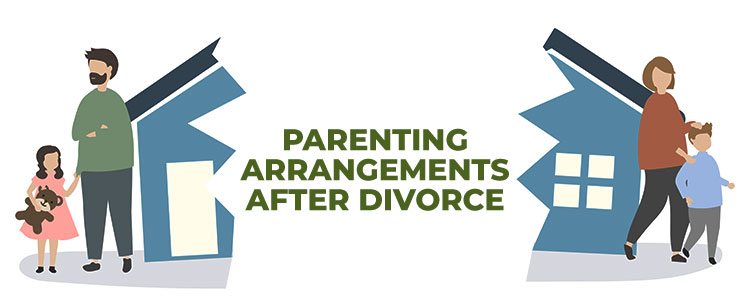
Parenting Arrangements after Divorce

Parenting Arrangements

Divorce is painful for everyone concerned, especially children. During this challenging period, children need love, support and contact with both parents.

Creating certainty about the future is crucial for children when their parents separate. Parents coming to a mutual agreement about parenting arrangements can help to provide clarity and certainty.

When parents agree

Following separation, parents may agree on a parenting arrangement that works for them and the children. The agreement should focus on providing for the needs of the children and may include financial arrangements.

A parenting arrangement can be agreed orally, in writing or put into a formal court order known as ‘consent orders’ (which requires an application to the court but does not require a court appearance).

When parents don’t agree

If parents can’t agree on parenting arrangements, they can apply to the court for a parenting order. Usually (except in the case of family violence and other specific circumstances), parents are not permitted to apply for a parenting court order until they have first attempted family dispute resolution (mediation).

The court’s primary concern will be to protect the children from psychological or physical harm. The court will address this before deciding about parenting arrangements.

The Australian Government has published a book to help develop parenting plans. This resource can help prepare clear, practical parenting arrangements that are focused on what’s best for the children.

What to consider when creating a parenting agreement?

When making parenting arrangements, parents may consider a range of issues including:

  • The capacity of each parent to provide day-to-day care?
  • The age of the children?
  • The arrangements for the children before and after school and during  school holidays?
  • Will the children spend their time with other significant people in their lives, like grandparents or other relatives?
  • The children’s educational needs?
  • Any cultural considerations?
  • The special needs of the children, including educational and medical?
  • The children’s wishes, having regard to their age and stage of development?
  • Other practical considerations such as transport and accommodation expenses?

While a routine may be best for your children overall, flexibility is likely to be an essential ingredient of a parenting agreement.

Relocating with children

If you are thinking of relocating with your children at a distance that would dramatically affect the time they spend with the other parent, you will need to come to an agreement with the other parent. If agreement is not reached, an application to the family law courts seeking permission to relocate the children will be required.

The proposed relocation destination may involve moving intrastate, interstate or overseas. Consider how the relocation will affect the children’s relationship with the other parent and ask yourself the question ‘Would the move be in the children’s best interests?’ – the court will ask the same question.

What’s next?

Consider what is best for your children’s short-term and long-term wellbeing.

Work out what concerns need to be addressed in your parenting arrangement.

Decide whether you want the parenting agreement to be an informal oral or written agreement, a parenting plan signed and dated by both parents or a court order obtained by consent or by order of the court (judge made order).

Contact an accredited family law specialist or family dispute resolution practitioner to obtain the advice that you need to resolve your post-separation parenting issues. Our specialist solicitors and family dispute attorneys are able to help you with your parental rights.

Categories
Articles Articles Articles Articles Articles Articles Articles Articles Child Custody Child Support De Facto Relationships Divorce Property and Superannuation Same Sex Relationships Surrogacy

IAFL Global Comparison of LGBT Laws

The International Academy of Family Lawyers, of which Vanessa Mathews is a Fellow, has published a global survey of Lesbian Gay Bisexual Transgender laws (LGBT laws), the results of which can be found here https://www.iafl.com/media/5336/2019-iafl-lgbt-survey.pdf.

The IAFL LGBT Committee stated ‘Laws affecting LGBT people vary greatly by country or jurisdiction. There are now 28 jurisdictions that accept same sex marriage, however gay sex remains illegal in many jurisdictions with the death penalty still applying in 14.

The International Academy of Family Lawyers (“IAFL”) supports all efforts towards full equality of the LGBT community throughout the world and the end to rules that unfairly discriminate against such individuals and, in many countries, criminalize countless couples because of the ones they love. There remains a lot of work to be done.
The work done by some fellows of the IAFL is having a real impact and changing for the better the lives of LGBT people. The LGBT Committee of the IAFL commissioned this survey to capitalize on the knowledge and expertise of some members for the benefit of the IAFL as a whole and the LGBT community.

The individual submissions in this survey are the work of fellows of the IAFL who have kindly donated their time and expertise to answer the same questions as set out below. Each of the contributor’s names and contact details are included.

The LGBT Committee intends that this should be a living resource. We are asking those who have already kindly donated their time to keep us informed as laws change in their jurisdictions. We have detailed submissions from 46 jurisdictions, however, there remains a good number of jurisdictions not covered where the IAFL has fellows. If your jurisdiction is not covered and you feel able to complete a survey, please get in touch with the IAFL.’

Congratulations to the IAFL LGBT committee members for preparing such a comprehensive review of comparative laws.

Categories
Best Interests & Parenting Best Interests & Parenting child arrangements Divorce Divorce & Parenting Parenting Plans

5 signs that your child is affected by your divorce

child affected by divorce

Separation and divorce hurt. There’s no getting around that fact.

Without special care and attention, children can be the unintended victims of separation and divorce. For them, their parent’s separation can open a floodgate of emotions, which, for children of any age can be difficult to process and express.

Many of the parents we speak with of course to want to minimise the impact of their divorce on their children, but do not always know what signs to look for. So how can you identify the signs that your child may be being adversely affected by your separation and divorce?

Although every child is unique, there are some clear signs to look out for:

Your child is feeling sad and cries more than usual

Your child could be sad and cry a lot. It might be more difficult than usual to comfort them. They might cry for no reason or react disproportionately to that which to you seem to be minor issues.

The things they cry over may have nothing to do with the separation and divorce however due to difficulty in understanding and accepting the changes to their family, their ability to deal with other issues may be diminished and they can become easily upset.

Your child gets separation anxiety

You or your former partner might find that your children don’t want to leave your side, or that they want to stay with the other parent and resist going with the other parent.

Separation anxiety for children is common when parents separate. Their anxiety is a result of the significant changes they are experiencing and staying close to one or both parents are their way of managing it.

Your child is overly emotional and gets angry

When parents separate, it may cause the children to feel uncertain, insecure, worried or anxious. The complex emotions they feel and their inability to express their feelings may be ‘acted out’, such as angry verbal or physical outbursts or uncooperative behavior. Helping your children to express those complex emotions can help to release the anger and improve their well-being and anxiety.

Your child is withdrawn and has lost interest in activities

The stress of parents separating can result in children withdrawing into themselves and refusing to engage in activities they have enjoyed in the past. Some children stop hanging out with their friends, preferring to spend all their time in their room, keeping a distance from their family and doing things by themselves.

Decline in school performance

When children are tackling a stressful situation at home, it can directly impact on their performance at school. The stress at home takes so much of their attention and energy and they may have difficulty focusing in class.

At home, they may be anxious and distracted, unable to focus on homework, negatively affecting their academic performance.

The dip in academic performance can result in further anxiety for the child; they feel terrible about falling behind, compounding the situation with another stressful situation. If your child is struggling at school after separation, it is a good idea to inform the school about the situation at home.

Conclusion

Separated parents feel responsible for their child’s suffering. Parents must remain united in their commitment to ensuring that any adverse impact on their children is kept to a minimum, and, if any are identified they are immediately met with an appropriate united response. The conflict between parents will certainly exacerbate the impact on the children, potentially dramatically.

If you detect a dramatic change in your children’s behavior and emotions, and your efforts to support them aren’t helping, please seek urgent help. Early intervention can help both you and your children to get the support required to see you through this difficult time.

Recommended Post: Family Violence and Children at Risk

Categories
Family Violence Violence & Separation/Divorce

Financial Abuse

financial abuse law australia

Australian family law and the family law courts recognize the close connection between family breakdown and family violence, and the resultant impact this has on victims of family violence – both adults and children.

Often when we hear references to family violence, our minds instinctually think of ‘violence’ in the traditional sense and behaviors such as:

  • Physical abuse (such as hitting or pushing someone);
  • Sexual abuse; or
  • Emotional and/or psychological abuse (such as yelling or insulting someone, undermining their self-worth or humiliating a person).

Australian family law legislation provides a wide interpretation and definition of the term ‘family violence’ and The Family Law Act and the family law courts recognize financial abuse (or economic abuse) as a form of family and domestic violence.

Financial abuse (or economic abuse) occurs when you are unreasonably denied financial autonomy that you would otherwise have had, and are denied any control over your personal and/or the relationship’s finances. In many cases, this type of abuse is subtle and not obvious and can be difficult to recognize. Financial abuse can also manifest slowly over the course of a relationship – steadily ‘creeping up’ until it becomes the new normal.

Some common examples of financial abuse include (but are not limited to):

  1. Being denied financial autonomy and control of your own finances (e.g. a spouse/domestic partner taking complete control of the relationship’s money and finances).
  2. Being provided with inadequate funds and having money withheld to meet your (and your children’s) reasonable living expenses. This is especially the case in circumstances where you are entirely or partially dependent on your spouse/domestic partner for that financial support.
  3. Being constantly monitored, harassed and questioned about what you spend money on.
  4. Having access to your bank accounts and credit/debit cards is restricted or blocked.
  5. Being forbidden to work and earn an income of your own.
  6. Having your pay taken from you and your access to it restricted.
  7. Being made to feel that you are irresponsible and incapable of handling money.
  8. Your spouse/domestic partner refusing to work or contribute to household expenses.
  9. Your spouse/domestic partner incurring debts in your name (this is related to identity theft).
  10. Being forced to sign financial documents (such as mortgage documents or personal loans) without being allowed to read or consider them.

Financial abuse is often accompanied by other forms of family violence, such as verbal abuse (e.g. angry outbursts and threats of violence), as well as physical abuse. Experiencing financial abuse lawyer can be just as damaging as physical abuse, and the affected family members often aren’t aware of how to seek and access support.

Our accredited family law specialist solicitors are available to assist in matters involving family violence and financial abuse, along with all other facets of your family law matter. If you would like to speak to one of our family law specialists about any of your family law issues, from family law property to parental rights, please contact us on 1300 635 529 or email [email protected] for a free telephone consultation.

Categories
All Case Studies Separation

I have just separated from my partner with whom I have been living – What steps should I take?

If your former partner chooses to dispute the date you separated, you may be required to prove when the separation happened. You may be in a position where you live with your former partner temporarily while you make other arrangements. In this event, you will want proof of the date on which separation occurred. One way to prove you have separated from your partner is to have it confirmed in dated written format, ideally signed by both you and your former partner. If a written and dated document will be difficult to acquire, then a text message to your former partner can often suffice.

Proof of Separation

If a precise date of separation isn’t known because it was a gradual process that happened over some time, it may be required for the Family Court to determine when the separation occurred. In this circumstance, the Family Court will look at factors such as:

  • When did you and your former partner start sleeping in separate rooms?
  • Did either you or your former partner inform family and friends that you had separated?
  • When were you and your former partner’s financial affairs formally separated?
  • When were you and your former partner last intimate with each other?
  • When did you and your former partner stop carrying out domestic duties such as washing and cooking for each other?
  • When did you or your former partner lodge formal documents, such as ATO or Centrelink documents, on the basis that you were separated?

What are some of the first steps you can take following separation?

  • Setting up a bank account in your name may be a good first step to gaining financial independence. The date on which the new back account was created may also provide supporting evidence of when separation occurred.
  • Formalizing your separation may include agreeing with your former partner to close any joint bank accounts you have together. Arrange for any scheduled transfers to now be facilitated via a personal bank account that only you can access.
  • Carry out a financial audit to identify and value all the assets, liabilities and superannuation – in your name, your former partner’s name or an entity controlled by you and / or your former partner.
  • Obtain a copy of your current superannuation member statement.
  • Consider if it is necessary to protect yourself against the risk of your former partner drawing down from your bank accounts or incurring credit card debt without your prior consent and instruct your bank as to any protective action you wish to have taken.

Take the next step, contact Mathews Family Law

The next step is to book a free 15-minute telephone consultation with an accredited family law specialist at Mathews Family Law and receive specific advice about your situation. Our family law property lawyers and specialist solicitors are ready to help.

Book a free consultation with a divorce law lawyer online today.

Categories
Articles Case Studies Property and Superannuation

A Curly Case for the Commissioner of Taxation

family law firm
 

A CURLY CASE FOR THE COMMISSIONER OF TAXATION

CAO & TRONG AND ANOR [2018] FAMILY COURT OF AUSTRALIA

There is no escaping the Family Court and the Commissioner …

The wife filed an application for a final property settlement, including an order that:

1. The husband indemnify her ‘against any liability present or contingent including tax … in respect of E Pty Ltd’; and
2. The husband be responsible ‘for all income tax assessed on income received or deemed to have been received by the husband’.

In the period 2005 -2012, the husband incurred a tax liability of $5,519,200 (unpaid).

The Commissioner of Taxation sought leave to intervene in the property settlement proceedings and an order that the court first makes provision for the payment of tax liabilities to the Commissioner prior to any property distribution to the parties.

Before the matter could be determined by the court, the parties effectively withdrew their respective applications for final property settlement orders.

The wife advised the Commissioner that there was therefore now no basis for it to intervene.

The Commissioner was successful in its application for an order that the court does have the jurisdiction and power to determine a claim against a creditor pursuant to section 79 property settlement proceedings – even if the parties have withdrawn their applications.

The case was run by the Commissioner of Taxation as a ‘test case’ and confirmed that even when the parties themselves no longer seek the assistance of the court to achieve a final property settlement, if the Commissioner has already intervened in those proceedings, the court has jurisdiction to make a final order in its favor – and the liabilities owed to it enforced as an order of the Family Court.

In other words – there’s no avoiding the Commissioner – no matter what agreement the parties themselves might ‘agree on, there’s no way around their obligations to it.

I hope that the year is treating you well – even though it is flying by.

We continue to offer a free 15-minute telephone consultation to your clients in need of family law advice – they can call me on 9804 7991 or email [email protected] to book a time.

And remember, we’re always happy to help you out with your own ‘curly cases’.

Stay in touch,

Vanessa and the Team at Mathews Family Law & Mediation Specialists

Categories
Separation

I’m thinking of separating, what do I need to know?

Separation is never easy, especially when children are involved. There are always lots of issues that need to be addressed. You may need to organize new financial arrangements, possibly arrange new accommodation and transport. Then there is the difficult job of informing friends and family, which can affect your long-standing friendships. When children are involved a great deal of care needs to be taken to ensure their lives and wellbeing get impacted as little as possible.

Even if you are not married, separation can still be complicated and involve legal paperwork. When children, child support, maintenance and property are affected by separation, legal advice and formal documents of agreements reach is likely to be of assistance.

Disputes and Resolutions

Following separation, there may be disagreement about the management of parenting and financial issues. Family Dispute Resolution mediation, supported by your own specialist family law legal advice, soon after separation may be of assistance and help to avoid disagreements becoming entrenched.

Family Violence

Family violence is a major reason for relationship breakdown. If you are experiencing family violence, please contact your local police who can provide immediate assistance and / or family violence support service who can support you to understand your situation and help you to formulate options for moving forward. Legal advice about parenting, child support, maintenance and property settlement issues from a specialist family law solicitor may be of assistance at this time.

Talk with a Mathews Family Law & Mediation Specialist

Just as no two experiences of relationship breakdown will be the same, there is no ‘one size fits all’ approach to the resolution of issues arising from the breakdown of a relationship – what works for one person may not necessarily be the right solution for you.

Mathews Family Law is one of the most experienced family law firms in Melbourne with the knowledge to guide you through the most challenging of experiences.

If you are contemplating separation or divorce, book in an obligation free 15-minute consultation with one of our accredited specialist family lawyers to understand your rights and options.

Contact us today for a free consultation with a family dispute attorney, to discuss family law property, parental rights, child support, and anything else you may need help with.

Categories
Uncategorized

Mathews Family Law & Mediation Specialists Family Law Podcasts

Practical Insights from Accredited Family Law Specialists

Welcome to the Mathews Family Law & Mediation Specialists Podcast Series, where we discuss common family law issues affecting individuals and families across Australia.

Hosted by Vanessa Mathews, Accredited Family Law Specialist and Principal of Mathews Family Law & Mediation Specialists, these podcasts provide practical guidance on a range of family law topics, helping you better understand your legal rights, obligations and options.

Whether you’re navigating separation, parenting arrangements, child support, property settlement or other family law matters, our podcasts offer clear, informative and easy-to-understand insights based on current Australian family law.

Browse our latest episodes below.


Vanessa Mathews discusses child support

Vanessa Mathews discusses the rights of grandparents

8th Oct

Categories
Case Studies Case Studies Case Studies De Facto Relationships Financial Agreements Property and Superannuation

Financial Loss During a Relationship – Case Note

In the recent Family Court case of Anaya & Anaya [2019] FCCA 1048, the principle in the long-established case of Kowaliw and Kowaliw was re-affirmed that:

As a statement of general principle, I am firmly of the view that financial losses incurred by parties or either of them in the course of marriage whether such losses result from a joint or several liability, should be shared by them (although not necessarily equally) except in the following circumstances:

  1. Where one of the parties has embarked upon a course of conduct designed to reduce or minimize the effective value or worth of matrimonial assets; or
  2. Where one of the parties has acted recklessly, negligently or wantonly with matrimonial assets, the overall effect of which has reduced or minimized their value.

In Anaya, the husband argued that investment funds (including inheritance of $1,000,000) ‘lost’ by the wife should be ‘added back’ to the asset pool and treated as an advance on her property settlement. The wife argued that the losses were a matter to be taken into account generally and to have them ‘added back’ to the asset pool would likely result in hardship for her.

His Honour held that at the time the wife decided to enter into the high-risk investment she was likely to have been depressed and angry at the husband about their separation but that her decision to do so was reckless and fell within the second category of Kowaliw. The wife’s awareness was exacerbated by the timing of her decisions – after Family Court proceedings had commenced and she had legal representation.

I often have clients ask me to seek redress for losses ‘caused’ by their former partner, for example, the reduced value of their share portfolio or investment in a now worthless time-share resort. For the majority, my answer is no, that these losses were incurred in the course of the marriage but for some, however, the answer is ‘yes’, for example, money lost due to gambling.

It is important that each significant financial ‘win’ and ‘loss’ experienced during the marriage is objectively assessed in the context of its surrounding circumstances. An emotional assessment may be misguided and result in unrealistic expectations by the aggrieved client.

I am available to assist with this task – by offering an objective and realistic assessment of your client’s complex property settlements.

Please contact me at [email protected] or at 9804 7991 if you would like to discuss your client’s situation.

Or have your client contact me to arrange a free initial 15-minute telephone consultation.

Categories
Case Studies child arrangements Parenting Proceedings

The Role Of The Single Expert Witness In Child Custody Matters – Case Note

The role of the Single Expert Witness / Family Report Writer was considered in a recent child custody decision by the Family Court of Western Australia (Worrall and Bartley [2018] FCWA 132).

child support applications

In accordance with an earlier order that the interim parenting arrangements (child custody) for the nine-year-old child (who had been the subject of litigation for eight years) be reviewed after 12 months, the Single Expert Witness / Family Report Writer conducted his review and published a report.

The father sought that final parenting orders (child custody orders) be made in terms of the existing interim parenting orders or otherwise in accordance with the recommendations of the Single Expert Witness / Family Report Writer ‘on the papers’, that is without cross-examination of the parties and/or witnesses.

The mother objected on the grounds that:

  1. She did not consent to the making of final parenting orders as proposed by the father; and
  2. She did not accept the opinion evidence submitted by the Single Expert Witness / Family Report Writer and the child’s psychologist.

His Honor held that:

  1. It would be procedurally unfair to make final orders in reliance on the Single Expert Witness / Family Report Writer report without affording the mother the opportunity to challenge it in cross-examination;
  2. The simple acceptance of the recommendations of the Single Expert Witness / Family Report Writer, without affording the opportunity for cross-examination, might reasonably be perceived as an abrogation by the Court of its decision-making responsibility in favor of the Expert;
  3. A Single Expert Witness / Family Report Writer, no matter how experienced or qualified, is still simply that: a witness;
  4. The expertise of the Single Expert Witness / Family Report Writer renders his or her opinion evidence admissible, but the opinion remains subject to an assessment by the Court as to the weight to be given by it;
  5. While expert evidence is of great assistance to the Court and informs many of the decisions which must be made, the responsibility for making those decisions is the Court’s alone;
  6. A Court hearing will afford the Court the opportunity to ask questions directly of the Single Expert Witness / Family Report Writer and child’s psychologist, if appropriate.

For these reasons, His Honour declined to determine the matter ‘on the papers’ and the matter was listed for final hearing in the Family Court with cross-examination of the experts.

The Family Court child custody case upholds the principle of ‘procedural fairness and the importance of parties having the right to put all witnesses, including expert witnesses, ‘to the test’.

Mathews Family Law & Mediation Specialists is an award-winning best family law firm in Melbourne’s eastern suburbs recognised for its expertise in complex Family Court child custody matters, with child support lawyers ready to discuss your parental rights and family law property matters.

Please contact Vanessa Mathews on [email protected] or  1300 635 529 to arrange a free telephone consultation to discuss your child custody matter with one of the best family lawyers in Melbourne, accredited family law specialist, Vanessa Mathews.